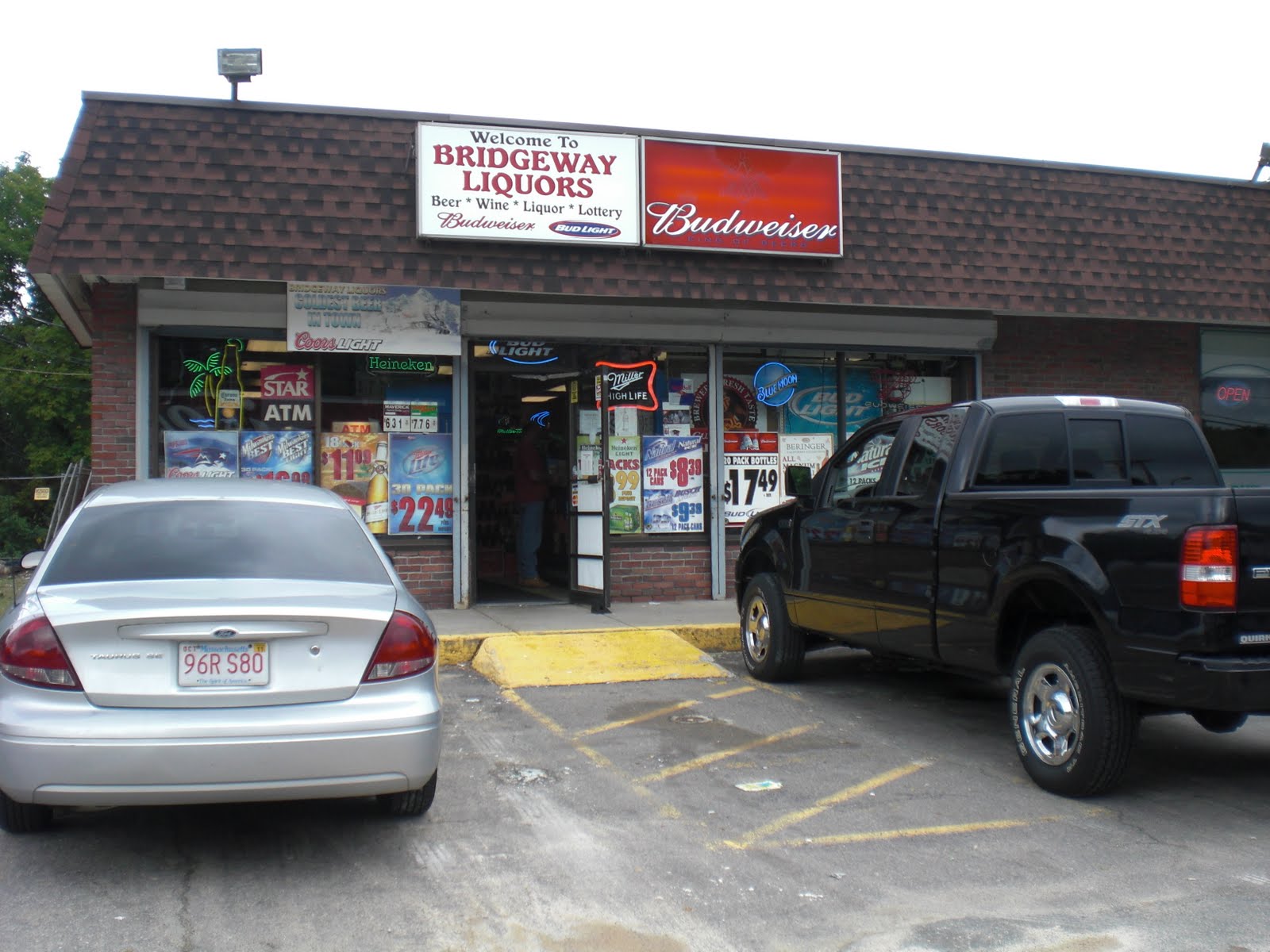
Tuesday, August 16, 2011

Investigation Continues In Bridgeway Liquors Shooting

By Lisa E. Crowley
BrocktonPost
BROCKTON—Police continue to investigate a shooting at Bridgeway Liquors Friday, Aug. 12 that took the life of a 19-year-old Brockton man.
Russ Eonas, a spokesman for Plymouth County District Attorney Timothy Cruz said James Ortiz, 19, of Brockton was killed Friday night at the liquor store at 142 Howard Street.
A Norwood man, Vincent Wadlington, 17, has been charged with unlawful carrying of a firearm, possession of ammunition without a license, and unlawful carrying of a loaded firearm, Eonas said.
Eonas said no one has been charged with homicide.
“The investigation is on-going,” Eonas said.
Wadlington was arraigned in Brockton District Court, Monday, Aug. 15, and held on $500 bail. He is scheduled for a pretrial conference Oct. 11.
Malkiat Singh, owner of Bridgeway Liquors, said he and his nephew were working Friday night and preparing to close, when at about 10:45 p.m. a group of cars pulled into the parking lot.
“They were yelling and fighting in the parking lot,” Singh said. “They came from somewhere else,” he said.
Singh said he heard the yelling and then three males ran through the store—two chasing one.
“One guy grabbed a bottle to defend himself,” Singh said.
Singh said none of the three men was Ortiz.
Singh said he told them if they had a fight to take it out side and leave the property.
As his nephew called police, Singh said he heard five or six gun shots and knew something bad had happened.
“He died right there,” Singh said pointing to an area of the parking lot in front of the store that is now covered in sand to soak up the blood from head, neck and leg wounds suffered by Ortiz.
Another man, 21-year-old Donte Ortiz, James Ortiz’s brother, was stabbed in the back.
"It all happened in five minutes," Singh said.
Singh said the suspects sped away, but some members of the group left cars in the parking lot, which police towed.

Thursday, August 11, 2011

Brockton Mosquito Spraying Begins Tonight

BrocktonPost
BROCKTON--The Brockton Board of Health has announced there will be mosquito ground spraying throughout the city and school grounds Thursday, Aug. 11, following test samples last week that detected the West Nile virus and Eastern Equine Encephalitis virus in mosquitoes.
In a prepared statement, the Board of Health said groundspraying will take place later this evening, Aug. 11, weather permitting, and will include the entire city, including all school grounds, playgrounds, Rox Stadium and Brockton fairgrounds.
Fifteen of the city's public and private schools will take place tonight, weather permitting, with the remaining schools to be done on Monday and Tuesday.
Brockton's playgrounds, schools, Rox Stadium and fairgrounds were sprayed at the end of June, early July, but because of the detection of the diseases, officials said the city requested the whole city be sprayed by Plymouth County Mosquito Control.
While no humans in the state have yet to contract either of the mosquito-borne illnesses, residents are urged to take precautions to prevent getting mosquito bites.
Click here for more information about precautions to prevent bites, test samplings, and state and local board of health contacts...

Wednesday, August 10, 2011

The Sometimes Scary, Sometimes Spectacular Power of Social Media

EDITOR'S NOTE: We at BrocktonPost.com are pleased to welcome Liz Downey as a contributing correspondent. Downey is a Norwell resident, who holds a master's degree in English from Bridgewater State College and in 2009 earned a bachelor's from Stonehill College in English and theater arts. We look forward to her submissions. She has her own website, http://www.lizdowney.com/ and can be reached via email at etdownney@gmail.com.


By Liz Downey
BrocktonPost Correspondent
Two weeks ago, a popular Southern California DJ who goes by the name of Kaskade tweeted about what was supposed to be a small, private, invitation-only film screening of The Electric Daisy Carnival Experience at Grauman’s Chinese Theatre in Los Angeles.
He spilled the details of this event in a single 140-character hiccup that echoed to the timelines of his 90,000 followers:
“ME+BIG SPEAKERS+MUSIC=BLOCK PARTY”
Of course, it wasn’t until that evening when Kaskade, overcome by police riot squads, circling helicopters, and thousands of fans who filled the streets of Hollywood's Sunset Boulevard, tweeted:
“EVERYONE NEEDS TO GO HOME NOW. I DON’T WANT THIS TO REFLECT BADLY ON EDM OR WHAT WE ARE ABOUT. BE RESPECTFUL AND CHILL OUT!!!”
He just tweeted that a little too late.
Many of the thousands were already out-of-control, jumping on top of squad cars, and subsequently, arrested.
For those of you unfamiliar with Twitter, adding a hashtag (#) to a word or phrase can help it trend on Twitter. For something to trend on Twitter, great numbers of people have to tweet about the hashtagged keyword or phrase in order for it to show up on the Twitter website as a “trending topic.”
Today, my boyfriend messaged me about a startling, trending topic on Twitter: #reasonstobeatyourgirlfriend.
The “trend” was tweeted amongst hateful and angry statements and inappropriate uses of humor.
It was also met by users horrified by the trend, who sought to renounce anyone making light of physical abuse.
Of course, these do-gooders overlooked the fact that replying to and reusing the hashtag only strengthens its “trendiness.”
What probably began as one inappropriate joke grew to unimaginably large proportions because it was broadcast on the Internet.
What these stories really should be telling you is that what you say matters. Yes--it does.
What you say on the Internet matters beyond the scope of your imagination.
And yet, this power can be also used for good.
If you say interesting things, seem likeable and passionate about your topic, you will harness more of an audience. Crafting the perfect tweet or Facebook status can generate more of these people. Eloquence is empowered if your message has a call to action.
In this case, saying stuff online can be a lead generator for your business.
Social media has also been the hub of legal change.
The Casey Anthony Trial was the biggest trial to date on social media sites. I think, of course, that this trial will be surpassed at some point by an even more dramatic trial. Further, the population of people on these sites will continue to grow as the population does.
However, the important part is this: everyone had something to be mad about with Casey Anthony. Because of social media outlets, users were able to articulate specifically why they were enraged at her release: not notifying police of her daughter’s disappearance.
In response to the heavily texted and tweeted discussion, the people came together on Facebook creating a group to advocate a new legal measure called “Caylee’s Law” after Anthony’s daughter which would make it a criminal act not to report you child missing within 24 hours of his or her disappearance.
The page has over 690,000 Facebook Fans. The petition has over 1.25 million signatures.
Countless other examples could be cited. On the small side, pets and owners are reunited much more quickly.
On the large side, Egyptians used social networking to overthrow their government. Either way, it should be clear to you, reader, that social media isn’t a fad. It’s not going away.
It’s a force to deal with and to master.
Click here to view videos of the Kaskade riot on YouTube...
(Twitter logo courtesy of Twitter.com. Egypt riot photo courtesy of friezsnake-YouTube. Caylee Anthony photo courtesy Change.org. Casey Anthony photo courtesy Facebook)

Verizon Strikers Say They Are Defending The Middle Class

By Lisa E. Crowley
BrocktonPost
BROCKTON—Verizon worker Vic Smith of Bridgewater said union members will do what it takes to save jobs from being sent overseas and to protect the middle class, as he and dozens of other striking workers picketed at two locations in Brockton.
“We’re all standing here together,” Smith said Tuesday afternoon as he (pictured at top) and more than 30 other Verizon employees made it difficult for the telephone company’s trucks to enter the plant at the end of West Chestnut and Pearl streets, on the West Side of Brockton.
As Smith spoke, fellow strikers struck up a chant, shouting “we’re united," and passersby heading to area shops and restaurants, honked their horns and waved.
Two Brockton police officers, hired by Verizon, slowly moved a group of 5 or 6 strikers from the path of the Verizon truck as it pulled in at the intersection of Pearl and West Chestnut, a 50-yard strip of road leading to the plant.
When picketers moved, the truck rolled a few yards toward an open fence where a core group of about 30 strikers carried signs and blocked the entrance to the Verizon plant.
Sting's "Message in a bottle" blared from a car stereo parked on the side of the road where employees set up beach chairs and tables.
The two police officers slowly walked to the strikers, who broke their circle and formed on each side of the truck.
The driver--either an active or retired member of Verizon management who has been trained to step in during emergencies and strikes—pulled past the group and into the facility as strikers shouted at him.
Strikers said they live in Brockton, Bridgewater, Raynham, Taunton, Easton, Whitman, Abington and other towns across the South Shore and have joined more than 45,000 members of the International Brotherhood of Electrical Workers and Communication Workers of America from Massachusetts to Virginia in a battle with Verizon management over what strikers call the battle for the middle class.
In Massachusetts, 6,500 IBEW and CWA workers have joined the strike.
Union workers went on strike at Midnight, Sunday, Aug. 7, after negotiations with company heads in Rye, New York ended Saturday with no agreement on a new contract.
Local union leaders said when the unions' three-year contract expired Saturday night with no agreement, the unions had no choice, but walk off the job.
“Going on strike is an absolute last resort,” said Eric Hetrick, business manager of IBEW Local 2322, which represents members in Southeast, Mass., Cape Cod and the Islands.
“The last thing a union business manager wants to ask its members is to strike,” Hetrick said.
Hetrick said IBEW workers who are participating in the strike will begin paying their own bills after this week when they get their last check from Verizon because the IBEW does not have a defense fund to help pay bills while workers are on strike.
CWA members, Hetrick said, have had additional dues set aside for a defense fund and believes members have about two months before the fund runs out.
The last Verizon strike was in 1989. It lasted 17 weeks.
Picketers downplayed reports of sabotage and cut lines in Tewksbury and Plymouth, noting crying sabotage and cut lines is the first play in management’s playbook during a strike.
Verizon officials could not immediately be reached for comment, but a prepared statement on the company’s website notes the contract includes employees who work in Verizon’s landline operations, which has lost nearly 60 percent of its customers over the last 10 years, while Verizon’s cellphone customers have increased by 94 million during the same period.
Picketers said Verizon, which netted a profit of $16 billion last year, is being greedy and only wants to give bonuses to its head managers and destroy the middle class.
Hetrick said the $16 billion profit was after “everything right down to paying for paper clips” and workers believe the company has plenty to offer employees without damaging the company’s bottomline.
“We’re not talking about getting rich here,” Hetrick said. “Workers want to be able to buy a house, raise their kids and send them to college, and pay their bills. None of us are going to get rich on what we’re asking,” he said.
Hetrick said one of the main points on the table is Verizon’s demand it be able to move thousands of customer service employees who handle landline billing and service calls from customers in the Northeast to the Philippines and India.
“It’s about losing jobs here in the Northeast. Here in the United States,” Hetrick said. “It’s a bitter pill to swallow," he said.
Another sticking point, Hetrick said, is Verizon’s demand employees pay for health care costs.
He said Verizon has asked employees to pay on average $4,000 to $6,000 per year for health care insurance.
Hetrick said Verizon employees currently do not pay anything for health care premiums.
He said he understands millions of Americans often pay an 80-20 percent share, with employees paying 20 percent, of health care costs, but added IBEW and CWA representatives have offered health care proposals where employees would still not pay any premiums and it would save Verizon money.
He said Verizon officials would not discuss the unions’ counterproposals.
Negotiators met in New York Monday and Tuesday, and were expected to resume talks this morning.
Picketers in Brockton said, although it may be difficult if the strike is prolonged, like 1989 when it lasted more than four months, they said they are fighting for the middle class.
"We're united, we're united, we're united," they shouted.


Tuesday, August 9, 2011

Officials Offer Precautions To Avoid Mosquito Bites

BrocktonPost
BROCKTON--FROM THE BOARD OF HEALTH:
The City of Brockton Board of Health was notified Friday, Aug. 5 by the Massachusetts Department of Public Health that West Nile virus and Eastern Equine Encephalitis virus have been detected in mosquitoes collected from the city.
State Board of Health officials said there have been no humans infected with either mosquito-borne virus, so far, in 2011.
Bridgewater, Brockton, and a host of other communities this summer have been identified as having mosquito samples bearing the viruses, and officials urge residents to take precautions to avoid contracting the illnesses, including using specific insect repellent, staying indoors during peak mosquito hours and repairing ripped or broken door and window screens.
During 2010, according to state Board of Health statistics, seven Massachusetts residents were infected by the West Nile virus. Residents in Hampden, Worcester, and three in Suffolk County were treated for either fever or meningoencephalitis.
No human in Plymouth or Norfolk County contracted the infection during 2010, however nationwide the number of West Nile virus cases increased in 2010 to 981 cases versus 720 in 2009.
Here are a few steps to take to avoid getting mosquito bites:
Avoid Mosquito Bites
•Apply Insect Repellent when Outdoors. Use a repellent with DEET (N, N-diethyl-m-toluamide), permethrin, picaridin (KBR 3023), oil of lemon eucalyptus [p-methane 3, 8-diol (PMD)] or IR3535 according to the instructions on the product label. DEET products should not be used on infants under two months of age and should be used in concentrations of 30% or less on older children. Oil of lemon eucalyptus should not be used on children under three years of age.

•Be Aware of Peak Mosquito Hours. The hours from dusk to dawn are peak biting times for many mosquitoes. Consider rescheduling outdoor activities that occur during evening or early morning.

•Clothing Can Help Reduce Mosquito Bites. Wearing long-sleeves, long pants and socks when outdoors will help keep mosquitoes away from your skin.

Mosquito-Proof Your Home
•Drain Standing Water. Mosquitoes lay their eggs in standing water. Limit the number of places around your home for mosquitoes to breed by either draining or discarding items that hold water. Check rain gutters and drains. Empty any unused flowerpots and wading pools, and change water in bird baths frequently.

•Install or Repair Screens. Keep mosquitoes outside by having tightly-fitting screens on all windows and doors.

More information is available on the DPH website: www.mass.gov/dph/wnv.
Information about WNV and Eastern Equine Encephalitis is also available by calling the DPH recorded information line at 1-866-MASS-WNV (1-866-627-7968), or the Epidemiology Program at 617-983-6800.


Monday, August 8, 2011

Brockton PD Nab Suspect Behind Bushes

By Lisa E. Crowley
BrocktonPost
BROCKTON—A 37-year-old Springfield man faces armed robbery charges after a Brockton Police canine found the man hiding in bushes near Walnut Street, not far from where a man fled from a purple Plymouth Neon suspected in two gas station robberies in Stoughton Sunday morning.
Brockton Police Capt. Manuel Gomes said Brockton Police caught Samuel Stovall, 37, of Springfield, after a more than 60-minute search led police and canine officer Mason, to the Walnut Street and Crowell Street area—about 1/2 mile from where a purple Plymouth Neon crashed at the intersection of Hereford and Pleasant streets.
“I like to tell the guys, you didn’t catch ‘em, the dog did,” Gomes said, noting the officers involved did a great job tracking down the suspect.
Stovall was transported to Stoughton where he was arrested and expected in court this morning for arraignment.
The search for Stovall began Sunday, Aug. 7 at about 9:30 a.m. when a bulletin to local police departments from Stoughton Police reported a man with a knife allegedly robbed the Prestige Gulf on Turnpike Street and Stoughton Gulf on Dykman Way.
Police were alerted the man used a knife to force cashiers at both stations to turnover an undetermined amount of money.
Gomes said Brockton Officer Albert Gazzaro spotted the Plymouth Neon in Brockton, turned on his siren and began to chase the vehicle.
After a short distance, Gomes said, the car crashed at the intersection of Hereford and Pleasant Streets. The driver, a black male, ran out of the car leaving a female passenger behind.
Gomes said a call went out to area canine units, including State Police.
Police set up cruisers at various intersections surrounding the N. Warren Avenue area from Pleasant Street, including Crowell and Walnut streets as they searched for the run away man.
Brockton Officer John Sturdevant arrived and canine officer Mason began to pick up the scent from the crashed vehicle.
Gomes said the woman in the vehicle helped police with information about where Stovall might try to run and what the pair had been doing prior to the accident.
As Sturdevant and Mason scoured the neighborhood, other officers questioned walkers and those in driveways.
Police found a hat and a shirt Stovall may have discarded as he ran away from the accident scene.
Gomes said Stovall was eventually caught at about 11 a.m. behind a house hiding behind bushes near Walnut and Crowell streets.
Gomes said Stovall has dozens of misdemeanors and felonies, including numerous drug and robbery convictions, dating back to a juvenile criminal past.
“He is well-known to authorities,” Gomes said. “Obviously, he is a career, a habitual criminal,” he said.
Gomes said in the crashed car police found a large, folding knife and cigarettes that allegedly link Stovall with the Stoughton robberies.

Tuesday, August 2, 2011

Power Plant Sides Vow Fight To The End

By Lisa E. Crowley
BrocktonPost
BROCKTON—Opposite sides of a battle to construct or stop a proposed 350-megawatt power plant in Brockton are claiming victory after a decision by the state Department of Environmental Protection has given its approval to a needed air quality permit for the project and has rejected the city’s and opponents’ claim the area is subject to Environmental Justice restrictions.
Jonathan Winslow, project manager for Brockton Power, the company that has proposed building the $350 million natural gas plant on Oak Hill Way, said the air permit approval by the DEP is a clear sign the project will meet the environmental standards necessary for the project—despite opponents’ assertions the project will be a health and safety risk to the surrounding community.
“We cleared a major regulatory hurdle when the DEP approved the air permit,” Winslow said.
In its approval issued last month, the state DEP concluded “the project site is not located in an Environmental Justice area as determined by the Executive Office of Energy and Environmental Affairs.”
The approval notes the “nearest Environmental Justice areas with low income and/or minority populations are 1,000 feet to the west, 1,700 feet to the north, and 2,100 feet to the east,” and concludes, “the project site property lines do not border any Environmental Justice neighborhood. The industrial park does not include any residents and therefore is not an Environmental Justice neighborhood.”
While power plant officials count the DEP’s decision as a win, so do the opponents of the project, including Brockton Mayor Linda Balzotti.
“They are not in a good position at all,” Balzotti said.
She said she believes the city and an opponents’ group Stop The Power gained a victory because the decision also includes a stipulation that because the power plant is not under construction as of July 1, 2011 the project will need to gain another permit, Prevention of Significant Deterioration, or PSD, from the Massachusetts DEP that measures ambient air quality.
“They now have to get the PSD, there is an appeal of the air permit and we are putting that together now,” Balzotti said. “The air permit is not the be all, end all,” Balzotti said.
Eddie Byers, a leader in Stop The Power, initially believed the PSD permit would hold the power plant to a higher air quality standard, however, he is not sure what the new rules will mean.
"The PSD is another layer, another requirement they have to go through," Byers said.
Brockton Power’s Winslow said he disagrees with Byers' assertion the PSD permit will require air quality standards.
He also noted power plant officials fully expected the PSD requirement, with or without the DEP air permit approval because it was known by all parties as early as April, when Balzotti received a letter about the permit.
“We knew all along we would have to seek the PSD. The PSD is not a requirement that is a result of the DEP air permit approval,” Winslow said. “I don’t know why they think the standard is higher. Contrary to some public statements by city officials and opponents, the standards that will be used are equivalent to those used as a part of the DEP air permit process,” he said.
Gene Benson, legal counsel and services program director with Alternatives for Community and Environment, who is working with Stop The Power, said it is unclear if the PSD standards for air quality, which regulate greenhouse emissions such as carbon dioxide, will be the same because the permit is a new requirement with the state DEP.
In the past, Benson said, the state DEP regulated the PSD permit, then authority transferred to the the federal EPA and recently authority has bounced back to the state level.
Benson, who has been on vacation, said he has not had a chance to research the PSD standards, but said power plant opponents have disagreed with the state DEP’s decision on the air permit and are working on an appeal.
“We raised a number of issues during the draft and believe some of the findings are erroneous,” Benson said, noting laws do not put a cap on greenhouse gases.
“The law doesn’t prohibit air pollution. It says you can only pollute so much,” Benson said.
The PSD standards are not the only issue at dispute over the power plant and it looks as if the battle will continue at least for a few more months.
There are several suits and appeals in Superior Court and Land Court over the project and eventually Brockton City Council will have to make a decision that would allow or prevent the use of city water as a part of the project.
The most recent decision by the Energy Facilities Siting Board has favored opponents when the board rejected the use of the city’s drinking water to cool the plants’ turbines.
The power plant has offered to pay the city $3 million a year to use the drinking water after the city rejected a plan for the power plant to pay the city $500,000 per year for treated waste water to cool the turbines.
Winslow said power plant officials have requested the EFSB revisit the drinking water decision and awaits the board’s review of its request, expected in late August or September.
Many opponents of the power plant have said they hoped power plant officials would pack up and go away if opponents held out long enough or cost power plant backers enough money that an ongoing battle would not be worth it.
A source close to power plant officials said about $20 million has been spent so far to bring the power plant to Brockton, and there is no expectation that the company will fold its tent and seek another location.
Private investment firm Siemens, the company that is behind Brockton Power, according to public documents has pledged $350 million to pay for the project.
“This isn’t about money,” Winslow said. “We’ve appealed the denials that are unjust to the core. The location is zoned for an electrical plant, it’s in an industrial park. If you can’t build it there, you can’t build it anywhere,” he said.
Winslow said Brockton Power, even in the face of stalwart opposition, does not plan on going anywhere.
“This is the business we’re in,” Winslow said. “We believe this is a good project. We have made many changes to make it an even better project…and we believe it will be a great benefit to the community,” he said.
He said the site has been zoned for more than 40 years for an electrical generation plant, it will bring much needed revenues and taxes to the City of Brockton, and the project has received nearly all the major state and federal approvals necessary to build the plant and are fighting the denials of local construction, environmental and zoning permits.
According to William Bottiggi, general manager of Braintree Electrical and Light Department, which opened in June, 2009 a town-owned and operated 110-megawatt natural gas plant near the Braintree Red Line station, said off the top, the proposed Brockton power plant could generate more than $1 million per month from ISO New England, a public-private company that oversees and regulates the wholesale electricity market for New England.
Bottiggi said, while the price per kilowatt of power changes and generators can participate in an auction that could increase or decrease those revenues, but electrical plants have been paid between $4 and $4.50 per kilowatt of electricity until June when the price dropped to $3.12 per kilowatt per month, which has been locked-in until May 2012.
The Brockton power plant is expected to generate up to 350-megawatts of electricity per month, or about $1.1 million per month at $3.12 per kilowatt, if the Brockton plant reaches the 350-megawatt capacity.
“That is a payment just to operate,” Bottiggi said.
Bottiggi said the power plant would also make more money from any residential, business and commercial customers it would sell its power to, but added it is difficult to calculate how much money the power plant could generate because of fluctuations in prices, state regulations, and service packages that offer discounts for low-income and bulk users.
Power plant officials have said the plant’s electricity would be sold to about 150 to 200 customers in Connecticut. (Correction: Brockton's power plant would supply about 230,000 households with electricity to the ISO grid)
Stop The Power's Byers said opponents plan to fight the project until the very end, and believes residents against the project have an ace in the hole: the power plant’s need for drinking or treated wastewater to cool the plant’s turbines—an approval that comes from the Brockton City Council whose members, except for Councilor-at-large Todd Petti, have been against the project and have said they will reject any city water for the project.
“If the city and the residents don’t want it, it’s not going to go through,” Byers said.
(Photo above shows a 170-megawatt natural gas plant in Dighton)